It Looks Like Nowhere in Europe
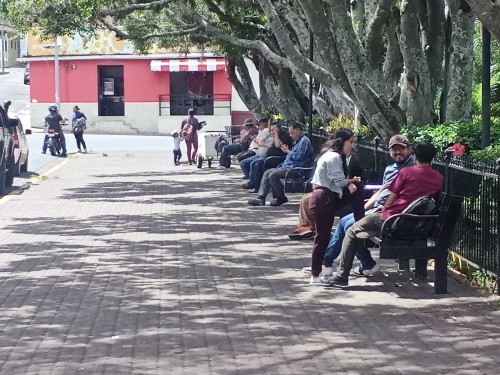
Start with what you see. Volcanoes rise behind lakes, tin roofs bake in the sun, mototaxis rattle through the streets, horse carts share the road with pickup trucks, and hammocks hang on every porch. The faces are mestizo, the heat is real, and the colours are loud. Nothing about Nicaragua looks like Europe, and nobody who arrives expects it to.
Then someone greets you. At the bus stop, in a shop, on a mountain path, a stranger says good morning and means it. An older man is addressed as Don, an older woman as Doña. People use the formal "usted" with anyone they respect, and they ask about your family before they ask about your business. Shirts are tucked in, shoes are shined, and a conversation is never rushed.
To be clear, we do not mean that Nicaraguans are European. Most are mestizo, with indigenous, African and European roots, and the culture is entirely their own. We mean something about character: a set of values that many Europeans remember as their own grandparents' values and fear they have lost. The look is Central American. The conduct is old-world.
Anstand, Honour and the Word That Means Both School and Manners
German has a word that is hard to translate: Anstand. It means decency, upright conduct, doing the right thing even when nobody is watching. It is not about money or status. It is about how a person carries themselves.
Spanish has its own versions, and they are woven into everyday speech. "Educación" means schooling, and it also means good manners, so a "bien educado" person is both well taught and well behaved. To have "vergüenza" is to have a sense of shame, of knowing what you should not do, and to be a "sinvergüenza" is to be without it, which is one of the harshest things you can say about someone. Your "palabra", your word, is meant to be kept.
That is what many newcomers notice first. In the towns we know, people treat education and decency as one subject. A child is expected to greet adults, thank the cook, stand when an elder enters, and do well at school. These are not extras. They are what makes a person respectable, and the whole street watches and approves.
A Moral Frame Built on Faith, Family and Work
The religious map is simple. Nicaragua is overwhelmingly Christian. According to Latinobarómetro, more than 80% of the population was Christian as of 2020, and a 2025 poll found 38.3% Protestant and 28.3% Catholic. An earlier 2019 survey put the split at 43% Catholic, 41% evangelical and 14% religious without affiliation, with Jews, Muslims, Jehovah's Witnesses, Mormons and nonbelievers together making up under 2%. Muslims, in other words, barely register.
What that shared faith produces is less a theology than a social grammar. Sunday is still Sunday. Elders are greeted before anyone else. Marriage, children and the family house are taken seriously, and a person who does not work is regarded with mild suspicion. Many visitors from secular Europe describe the effect as nostalgic: a country where people still agree, mostly without discussing it, on what a decent life looks like.
Education as a Matter of Honour
The strongest expression of those values is the school. Sending a child to class is a point of pride, almost a public statement. The uniform is ironed, the shoes are polished, and the socks are astonishingly white. Many households have no washing machine at all, and still the children arrive spotless, because a clean child is a signal to the whole street that this family is not giving up.
There is a philosophy hidden in the white sock. Dignity does not need money, but it does need effort and routine, and it needs a person willing to be seen making that effort. A mother scrubbing a school shirt by hand at dawn is making a statement about how she understands her place in the world.
The institutions behind that pride are larger than most people expect. The national council of universities lists 58 accredited universities, a core of state-funded institutions alongside many newer private ones. Public higher education is free by law: the 2021 higher-education law states that university education is tuition-free. Scholarships support students further. About 19,650 were granted through the national council in 2024, and a former council president reported that the total, including private universities, would reach roughly 50,000 in 2025.
The reality, as usual, is more complicated than the pride. Demand outruns supply, and even the council's own president has admitted that public universities do not have the capacity to take every high-school graduate. Adult literacy sits at around 82-83%, so the national ambition is real but the work is unfinished. The pride is there, and the resources are still catching up.
Safe Streets and Children at Play
In the towns we know, children still play in the street until dark. Drivers slow down around them, cyclists swerve politely, and dogs and bikes alike seem to understand that the street belongs to the kids at that hour. In most of Central America that scene would be unthinkable.
The statistics have long supported the impression. Nicaragua's homicide rate has been reported at around 6 per 100,000, roughly half of Costa Rica's, and a fraction of Honduras or El Salvador in the comparison year used. A United Nations development-programme report earlier found the rate had dropped from 12 to 8.7 per 100,000. A 2014 report noted that while Nicaragua is poor, it is also considered the safest country in Central America, one reason fewer of its youths joined the migration north.
Poor on Paper, Rich in Mornings
On paper, Nicaragua is one of the poorest countries in the Americas. By some measures, its people are among the most emotionally positive anywhere. Gallup's Positive Experience Index asks whether people laughed, felt respected, enjoyed themselves and learned something the day before. In 2019 Nicaragua scored 82, and in 2022 it scored 82 again, in a group of countries led by Indonesia, Mexico, Paraguay, the Philippines and Vietnam at 85. By comparison, the worldwide average has hovered around 71. In 2014, the entire top ten was Latin American.
A fair reading needs one more fact. That index measures yesterday's emotions, not the quality of a whole life. The UN's World Happiness Report, which looks at life overall and weighs factors like life expectancy, freedom and corruption, produces quite different results. Both findings are true: a day full of warmth, conversation and laughter can sit alongside a life with real material limits.
The philosophical point is old and uncomfortable. Wealth buys comfort, and comfort is not company. A society that is rich in neighbours, in shared meals, in children running through the street and grandparents on the porch has found something that most rich societies are now trying to buy back. Nicaraguans, rich in that second currency, often feel the poverty less sharply than the statistics suggest.
Where the Old World Came From
Part of the answer is history. The Spanish conquest arrived in the sixteenth century and left behind the language, the faith, the street grid of the colonial towns and the plaza at the centre of each one. It also left a history of violence and extraction that the country is still working through. The buildings may look nothing like Europe, but the moral vocabulary of honour, shame, manners and family came with that inheritance, and it was filled with indigenous, African and mestizo life until it became something entirely Nicaraguan.
The Germans of the Coffee Mountains
Spain was not the last European layer. In the nineteenth century a second wave arrived, smaller but very visible, and it settled in the cool green mountains around Matagalpa and Jinotega. The government of the day encouraged European immigrants, Germans and Italians among them, to buy land and plant coffee. The highlands, with their mild, spring-like climate all year round, turned out to be ideal.
The founding story, as it is told in Matagalpa, belongs to a couple. Ludwig Elster from Hannover and his wife Katharina Braun from the Black Forest planted the first coffee trees in the area, and the beans quickly found buyers in Germany. Local tradition adds that in 1852 they were travelling from New York to San Francisco when they changed their plans, bought a small farm called La Lima and stayed. Katharina is buried in Matagalpa, and the city still calls itself the capital of coffee.
They were not alone for long. Coffee attracted more than 120 European immigrants, many of whom married Matagalpan women, and many of their descendants still live in the area. Danish families arrived in the highlands in 1923, and three of them, the Gröns, the Möllers and the Petersens, stayed. Within a few decades Matagalpa washed coffee had earned an international reputation and was being shipped to the German ports of Bremen and Hamburg.
The best place to see that heritage today is Selva Negra, on the road between Matagalpa and Jinotega at kilometre 140. The name means Black Forest. The land was bought by a German immigrant, Hans Bösche, who built the La Hammonia estate and turned it into a shaded coffee farm that has been producing and exporting since 1890. Today the chalets look like a Bavarian village dropped into a cloud forest, the owners are fifth-generation German-Nicaraguan coffee planters, and the farm makes its own Gouda, Camembert, feta and sausages. The lodge even keeps the original railway wheel used to carry coffee down to the port of Corinto.
The influence is easier to spot in small things than in statistics: a cheese counter in a highland town, a wooden chalet roof, coffee growing under tall shade trees, estates passed through the generations, and surnames like Elster, Kühl and Bösche on farm gates. German-Nicaraguans are reportedly often bilingual in Spanish and German. This is one thread in a country that is overwhelmingly mestizo, not the whole explanation. But it adds to the northern mountains a work ethic, a love of order and a sense of craft that matches the values locals already live by.
The story did not end well for everyone. When Nicaragua, under Anastasio Somoza García, declared war on Nazi Germany in December 1941, Germans in the country were interned. Those who had not been naturalised were imprisoned, some were deported, and German-owned properties were confiscated and sold on, with Somoza himself among the buyers. By 1944 he was the largest landowner in the country, with dozens of coffee plantations. Some of the families who were forced out returned after the war.
The coffee boom was never a simple pioneer story either. It reshaped land ownership and labour in the highlands, and not always fairly. But more than a century and a half later, the highland coffee farms, the shade trees and the quiet German-named lodges are still part of what makes Matagalpa and Jinotega feel like their own small corner of the old world in the middle of Central America.
Why It Matters
People underestimate Nicaragua for a simple reason: they measure it in dollars and in skylines. By those measures it loses. By the measures people actually remember at the end of their lives, such as who greeted you, who kept their word, who walked home safely, who was proud of their children's white socks, it does remarkably well.
That is the real surprise. Nicaragua does not look like Europe, and it never will. But in its plazas and mountain farms, and in the way a stranger says good morning, you meet people who still hold to honour, effort, education and plain decency, and for many visitors that feels less like a foreign place than like something they had forgotten they were missing.