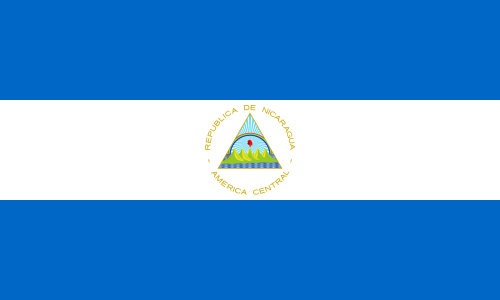
The flag of Nicaragua is one of the most symbolically dense national flags in the Americas. Its blue-white-blue stripes and its coat of arms (five volcanoes, a seven-color rainbow and a red liberty cap inside a triangle) go back to the 1823 flag of the Central American Federation. The current design was fixed by law in 1908 and detailed in 1971. This post covers its design, legal definition, symbolism, history and its contested political role today, including the 2025 changes.
TL;DR
- Design: Blue–white–blue horizontal triband, 3:5 ratio, with the national coat of arms centered on the white stripe. The law calls the blue "cobalt blue" but no official shade code exists.
- Dates: Passed by the Assembly on 4 Sept 1908, signed by President Zelaya on 5 Sept 1908. Standardized in detail by Law/Decree 1908 of 1971 (published 27 Aug 1971). Partly reformed in 2002 (Law 432).
- Ancestor: The 1823 flag of the United Provinces of Central America. The colors trace back (probably) to Argentine/Río de la Plata influence and, further back, possibly to the blue-and-white of the Spanish Immaculate Conception tradition.
- Official meaning (1971 law): Blue = justice and loyalty. White = purity and integrity. Popular reading: blue = the two oceans, white = the land between them.
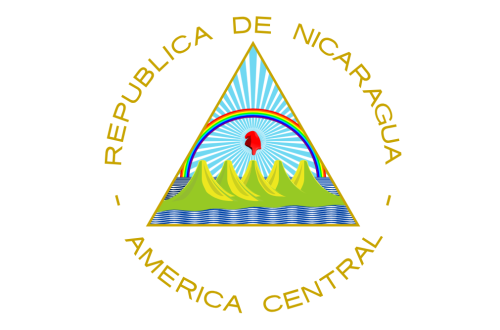
- Coat of arms: Equilateral triangle (equality), isthmus with chain of volcanoes (the five Central American states), two seas, seven-color rainbow (peace, includes purple), red liberty cap (liberty) with 45 radiating rays of light, gold ring: REPÚBLICA DE NICARAGUA – AMÉRICA CENTRAL.
- Surprising legal details: The flag never salutes or dips to anyone, gets a 21-gun salute, must be hoisted 6 AM to 6 PM, is folded into a triangle, and worn-out flags are burned privately.
- Politics (important): Since January 2025 the constitution also lists the red-and-black FSLN party flag as a national symbol. The 14 July Flag Day was abolished in May 2025 and replaced by 4 May. Independent media report that displaying the blue-and-white flag without permission has become politically sensitive since 2018.
1. The Flag at a Glance
Basic specification
- Official name: Bandera de la República de Nicaragua (also "Pabellón de la República" in the law)
- Ratio: 3:5 by law (some references show 1:2, which is not the legal ratio)
- Layout: Three equal horizontal stripes, blue / white / blue
- Emblem: National coat of arms in the center of the white stripe
- Blue: Defined in law only as "cobalt blue"
- One flag for all uses: The law does not distinguish a separate civil, state and war flag
Family resemblance
Guatemala, El Salvador, Honduras, Costa Rica and Nicaragua all descend from the same Federation flag. Each differentiated itself later: Costa Rica added a red stripe, Honduras added five stars, Guatemala turned the stripes vertical, while Nicaragua and El Salvador kept the coat of arms. Nicaragua's is the one that stayed closest to the 1823 original.
2. Colors and Stripes
What the law says
- The 1971 law states the blue means justice and loyalty and the white means purity and integrity.
- The older popular explanation, repeated in a 1967 civic handbook by José S. Pérez Palma, says the white stripe is the national territory and the two blue stripes are the two oceans that wash it, the Atlantic and the Pacific.
- Other educational sources add words like equality, goodness and peace to the white.
An important nuance
Because the 1908 decree itself did not define what the colors mean, the symbolism you see in textbooks was layered on later. The decree only fixed the colors (blue and white), the stripe order and the arms.
The exact shade is fuzzy
- The 1971 law says "cobalt blue" and nothing more.
- Reference sources give different approximations: Pantone 280C, 281C and 300C all appear in different catalogs, and Wikipedia's hex value (a dark navy) differs from other digital renderings (a brighter blue).
- Vexillology archives stress that no official government source gives exact color codes for the flag.
- In 1967 Pérez Palma complained that the decree never fixed the size or the shade of blue and that flags were being made "capriciously."
- Historically the blue was often lighter. A 1915 flag book describes Nicaragua's merchant flag as pale blue and white, and the 1823 blue is described as lighter than today's.
3. The Coat of Arms in Detail
The law (Article 42 onward) describes the arms in surprising technical detail.
The overall structure
- Peripheral element: Gold capital letters in a ring. REPÚBLICA DE NICARAGUA runs across the top of the triangle, AMÉRICA CENTRAL below. The letters are sans-serif, all the same size and the same weight.
- Central element: An equilateral triangle standing on one side, with a gold border.
The triangle: equality
- It is the official symbol of equality.
- A 1967 handbook adds a second reading: the rectitude of the homeland and its institutions.
- It is a core Enlightenment and Revolutionary-era motif: liberty, equality, fraternity.
The isthmus and the two seas
- Near the base is a horizontal strip of land, an isthmus, touching both slanted sides of the triangle and described as "watered by both seas."
- One sea is drawn between the isthmus and the base, the other beyond it up to the horizon.
- The law says the waves must be shown in motion, with foam crests, in ultramarine blue with white foam.
The volcanoes: the five states
- A chain of five dormant volcanoes, evenly spaced and of equal height, in yellowish green, each lit on one side in yellow by the rays of the cap.
- They stand for the five republics of Central America (Guatemala, El Salvador, Honduras, Nicaragua, Costa Rica) and express the desire for union and fraternity.
- Heraldic note: A 1961 philatelic study insisted all five must be the same height because in heraldry "there is no perspective." The legal text itself (1971) is more ambiguous and describes a slight perspective foreshortening with the nearest volcano drawn slightly taller.
- Interesting wording change: In the 2002 reform the legal description says "a chain of volcanoes" and no longer says "five." The sources I found do not explain why. The symbolism is still universally taught as five.
The rainbow: peace
- The law specifies seven colors in standard order: red on the outside, then orange, yellow, green, blue, indigo and violet.
- It is drawn as concentric semicircles centered on the midpoint of the horizon. The inner three bands are shown whole, the outer four are cut off by the triangle's sides.
- Because of the violet/purple band, Nicaragua's flag is one of the very few national flags that contains purple.
- Official meaning: peace, within the nation and with sister nations. Popular readings add hope for a bright future.
The liberty cap: freedom
- A vermilion red Phrygian (liberty) cap shown in profile, with the tip folded toward the viewer's left and ear flaps hanging.
- It sits on the triangle's vertical axis just below the rainbow.
- Official meaning: liberty. Many sources add independence from Spain and a broader revolutionary heritage.
- Heraldic note from the 1961 study: the cap must face the heraldic right, because facing left would supposedly signify "bastardy" in heraldry. That is the claim of one 20th-century author, not a rule written in the law.
The rays of light
- The cap "sheds light" in 45 white rays, each 3 degrees wide with 5-degree gaps, with one ray falling vertically onto the horizon.
- The rays are not drawn over the rainbow. The rainbow overlays them.
- Popular reading: light of liberty, a new dawn. Note that the law never calls them a "sun," even though many websites do.
Prescribed size
For a flag of 1.50 m by 2.50 m the law gives exact numbers: the lettering circle is 45 cm across, the triangle has 32.5 cm sides, and letters are 2.5 cm high. The horizon sits 7.5 cm above the triangle's base. The rainbow's inner radius is 90 mm and outer radius 104 mm. All other sizes must scale proportionally.
Colors of the arms
Volcanoes yellowish green, seas ultramarine, sky pale blue with white rays, cap vermilion, border and lettering gold.
Gold versus silver lettering
The 1908 decree said state offices, legations, consulates, warships, merchant ships and military units use the arms with gold lettering, while subordinate offices use silver. The 1971 law fixed gold. Vexillology forums have long treated the "silver lettering" idea as partly a myth, but it does have a real 1908 legal origin.
4. The Holistic Reading
A map in cloth
Two seas, land between them, volcanoes on that land. The whole flag reads as a stylized picture of the isthmus.
A political creed
Equality (triangle), liberty (cap), peace (rainbow) and enlightenment (rays) form a compact statement of the Age of Revolutions.
A union that never fully died
The 1908 law explicitly says the symbols were adjusted to match those of the Central American Federation because Nicaragua "always aspires" to see that political entity reborn. That is why the ring says AMÉRICA CENTRAL and why the five volcanoes are on the flag. This is the single most important key to reading it: it is a unionist flag as much as a national one.
A flag that doesn't bow
The law says the flag, as the emblem of the homeland, neither salutes nor renders honors. Other flags are meant to honor it.
5. History and Development
Before independence
Nicaragua was under Spanish rule, part of the Captaincy General of Guatemala, and used Spanish colonial banners and city coats of arms.
Where blue and white came from
Several overlapping stories exist:
- Louis Aury (1818): A French-born corsair operating under a patent from Buenos Aires reportedly flew blue-and-white striped colors when he proclaimed a short-lived independent state on islands off Nicaragua's coast. Some authors see this as the first Central American use of Río de la Plata colors.
- Manuel José Arce (1822): The Salvadoran leader is credited by several Central American sources with first waving a blue-and-white flag when he led militias against annexation to Mexico, reportedly remembering the Argentine colors of Belgrano and San Martín. The 1823 Assembly adopted these colors partly as a tribute to him.
- Belgrano: The Argentine cockade (1812) was blue-sky and white. Argentine sources say the colors evoke sky and clouds, and the mantle of the Immaculate Conception.
- Carlos III's order: Several sources say the Spanish king used the Immaculate Conception's colors for his royal order, which could be a deeper origin.
- Caveat: The exact causal chain is debated. These are plausible lineages, not a documented single decision. One vexillology contributor also speculated that Masonic networks may have carried the symbolism, which is unproven.
1823: the founding decree
- The Constituent Assembly decreed the arms and flag on 21 August 1823.
- The decree text describes the arms as an equilateral triangle, a range of five volcanoes on land bathed by both seas, a rainbow above, and a gold-lettered ring reading "Provincias Unidas del Centro de América."
- The national flag for ports and ships: three horizontal stripes, blue top and bottom, white center with the arms.
- Merchant ships carried no arms. Instead the center stripe bore "Dios, Unión, Libertad" in silver letters.
- Military flags put the arms in the center stripe, the motto on top, and the unit type and number on the bottom.
- The original 19th-century emblem versions show the cap on a lance with cannons and rifles at the foot of the triangle. A 1961 study is not fully consistent on whether that was the Federation's or Nicaragua's own variant, but it says the 1908 version dropped these.
After the Federation
- Nicaragua kept using the Federation insignia, modified, after the union dissolved.
- A 1851 federal revival (the three-state union stemming from the 1849 Pact of León) used an emblem with three volcanoes and three stars.
1854: the experiment that didn't last
- On 21 April 1854 a legislative decree created a totally different scheme: a yellow stripe on top, white in the center, and "nácar" (mother-of-pearl) at the bottom.
- The arms were a circle with laurel branches, a single volcano, a civic crown and the motto "Libertad, Orden, Trabajo."
- Note: sources disagree on the colors. The decree text says yellow, white and nacre, but some modern summaries say yellow-white-scarlet.
- It was used only for limited periods. Blue-and-white came back in practice.
William Walker (1855–57)
Accounts conflict. One Nicaraguan source says Walker designed a flag on 11 Sept 1856 that kept blue and white, with a white stripe twice as wide as the blue ones and a red five-pointed star in place of the arms. A vexillology archive instead describes a red-white-red flag with seven stars, and its contributors doubt Walker's flag was ever a true national flag. Walker's actions were later declared null.
The mid-to-late 19th century
Vexillology sources record various versions (including a five-stripe flag around 1889) and uncertainty about which flags were in force when. The blue-white-blue pattern kept returning, especially under liberal governments.
The Miskito coast and 1894
Zelaya's government reincorporated the Atlantic coast in February 1894, lowering the Miskito flag and hoisting the blue-and-white flag there for the first time.
Greater Republic of Central America (1896–98)
Nicaragua, Honduras and El Salvador briefly formed a union again and used federation-style emblems. It collapsed in November 1898.
1908: the law that still defines the arms
- 4 Sept 1908: the National Legislative Assembly passed the decree. 5 Sept 1908: President José Santos Zelaya signed it. Some modern sources give slightly different dates (such as 11 Sept), which seems to reflect publication and later citation confusion.
- The preamble says Nicaragua had no law fixing its arms and flag in their current form and wanted them to match the Federation's, since Nicaragua aspires to the revival of the five-state union.
- Articles: the arms are a triangle with five volcanoes bathed by two seas, a rainbow above and the liberty cap spreading light beneath it, with the ring text "República de Nicaragua. América Central." National colors are blue and white, in three equal horizontal stripes.
- The 1961 study complained that the decree was not obeyed uniformly: official seals and flags often showed incorrect arms.
The 1912–1933 period
During the U.S. occupation the national flag remained blue-and-white. A blue anchor appeared on a merchant ensign variant, but it was not in the 1908 decree.
1971: the modern legal framework
- Decree No. 1908, passed by the Chamber of Deputies on 18 Aug 1971 and by the Senate on 23 Aug, signed 25 Aug, and published in La Gaceta No. 194 on 27 Aug.
- Set the 3:5 ratio, the cobalt blue, the technical description of the arms, protocol rules, penalties, Flag Day and the presidential sash.
- It was signed by Anastasio Somoza as president.
2002: partial reform (Law 432)
- Fines for disrespecting the symbols were raised (originally 100 to 500 córdobas, then 200 to 1,000, with up to 2,000 for profit-seeking misuse, plus up to 15 days' arrest).
- The tolerance for using the flag without the arms during national holidays was removed. It must now always carry the arms.
- The legal wording of the volcano chain was simplified (see above).
- The Red Cross and fire brigades were added to bodies using the arms.
1979 onward
After the Sandinista revolution a 1979 decree created a revolutionary flag pledge made before both the blue-and-white flag and the red-and-black flag. President Bolaños criticized this change in a 2003 Flag Day speech. A new "Promesa a la Bandera" decree (No. 50-90) was issued under Violeta Chamorro in September 1990.
6. Protocol and Etiquette (1971 Law, as reformed)
Honors and rules
- Never dips or salutes, because it represents the homeland itself. Foreign flags honor it first.
- Official salute: 21 cannon shots at independence ceremonies, presidential inauguration, and the opening and closing of congress.
- Hoisted at 6 AM, lowered at 6 PM.
- Must fly daily at the Presidential House and in all barracks.
- Citizens are required to hang it on their homes on Independence of Central America days and other designated days.
- Bystanders should stop and face the flag when it is raised or lowered. Civilians remove headwear, or may place the right hand over the heart.
- It takes the right-hand position (the viewer's left) relative to foreign flags, at the same pole height and size.
- Never place another flag on the same pole. It may not be draped over a monument being unveiled, may not be used as commercial advertising, and no text may be printed on it.
- When hung across a street, the flag should face east or north.
- Must never touch the ground or be allowed to brush furniture or passersby.
- Half-mast: raise it quickly to the top first, then lower slowly. Do the same when taking it down.
- Funerals: it may cover a coffin lengthwise, with the ties toward the head, and never goes into the grave.
- Folding: folded by two people into a triangle, base facing outward.
- Retirement: a worn flag is burned privately, unless it has historical value.
- Silk templates: the law ordered 19 reference flags in silk distributed to state bodies and universities.
The presidential sash
Made in the pattern of the flag, with the arms in gold lettering on the white band, 15 cm wide, gold fringe at the ends, worn only by the President.
7. Flag Day: 14 July, and Why It Changed
- 1971: A law declared 14 July the Day of the Flag. A separate 1971 decree made 14 July a national holiday to mark a 1970 convention that abrogated the Chamorro–Bryan Treaty (a 1914 agreement with the U.S.).
- 4 May 2025: The National Assembly approved a law establishing 4 May as the "Day of National Dignity and Day of the National Flags" and repealed Article 35, which had set 14 July. The date is linked to Sandino's rejection of the 1927 Espino Negro pact. La Prensa (an independent outlet) reported the vote at 91 in favor, none against.
- So any source still telling you Flag Day is 14 July is now outdated.
8. The Red-and-Black Flag (FSLN / Sandinista)
Origin
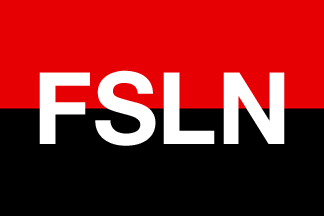
- A horizontal or diagonal red-and-black flag is associated with Augusto C. Sandino's resistance to the U.S. Marine occupation (1927–33).
- Sandino is quoted as saying the red and black stand for liberty or death, with "Patria y Libertad" as the army's official sign-off.
- Some accounts claim he adopted red and black after meeting Spanish anarchists in Mexico. Others say the colors were worn on neckerchiefs by his troops in the 1926–27 Constitutionalist War. Both are reported claims and I could not confirm a definitive documented origin.
- A flag captured in 1928 on the Coco River is preserved with Marine inscriptions, per a vexillology forum.
- Carlos Fonseca's FSLN (founded 1961) adopted the red-and-black as its own banner.
Constitutional status (2025)
- Ortega proposed in Nov 2024 to name the FSLN flag a national symbol. The National Assembly gave final approval on 30 January 2025, and the change was widely reported as in effect by mid-February 2025.
- Article 13 now lists the symbols as the blue-and-white flag, the red-and-black flag, the arms and the anthem, and references Sandino's anti-imperialist banners.
9. Speculation and Open Questions (Clearly Labeled)
These are interpretations or unresolved points, not settled facts.
- Did the blue and white come from Argentina or from the Virgin Mary? Both are plausible and may be linked. The Immaculate Conception link is an Argentine and Spanish tradition, not a documented Central American decision.
- Masonic influence? One vexillology contributor floated that South American symbolism was "embroidered" with Masonic symbolism and might have traveled that route. Some popular sites describe the emblems as Masonic or Enlightenment-inspired. I found no primary evidence.
- Why does the rainbow appear so prominently? The official line is peace and hope. A biblical reading (a sign after the flood) is a common speculative interpretation but not stated in the legal texts I found.
- The wording change from "five volcanoes" to "a chain of volcanoes" in 2002. Reasons are not given in the sources.
- The mystery 19th-century flags (1852, 1869, 1889 variants) are partly documented by vexillologists and partly attributed, so treat dates as approximate.
- Exact blue. The truth is that no single authoritative shade is documented.
- Plain flags. The 2002 law removed the permission to fly the plain triband, though FOTW contributors say plain flags have been widely used in practice.
10. Common Misunderstandings
- "The rainbow is a modern addition." No. The rainbow is in the 1823 decree itself.
- "The cap sits on a pole." That was true of older federal-era versions. The 1908 and current law describe the cap with its own rays, not on a lance.
- "It's the same as El Salvador's flag." Related, but Salvadoran arms include a different ring text, the date 15 Sept 1821, five flags and a laurel wreath, and the motto "Dios, Unión, Libertad."
- "Flag Day is 14 July." It was from 1971 to 2025. As of May 2025 the law points to 4 May.
- "The red-and-black flag isn't an official symbol." It was a party flag before, but since 2025 it is a constitutional national symbol.
- "Gold or silver lettering depends on rank." True only under the 1908 decree. The 1971 law specifies gold.
11. Quick Reference Table
| Element | Official / Traditional meaning | Notes |
| Blue stripes | Justice and loyalty (law); the two oceans (traditional) | Defined as "cobalt blue" |
| White stripe | Purity and integrity (law); the land (traditional) | Carries the arms |
| Equilateral triangle | Equality | Gold border |
| Five volcanoes | The five Central American states | 2002 law says "chain of volcanoes" |
| Two seas | Atlantic and Pacific | Ultramarine with white foam |
| Rainbow (7 colors) | Peace | Includes violet/purple |
| Liberty cap | Liberty | Vermilion red |
| 45 rays | Light of liberty | Not an official "sun" |
| Gold ring text | Identity as a Central American state | REPÚBLICA DE NICARAGUA / AMÉRICA CENTRAL |
12. Final Takeaway
The Nicaraguan flag is a compact record of geography, an unfinished federal dream and revolutionary-era ideals. Its look has barely changed since 1823, but its legal definition was only fixed in 1908 and 1971. In the 2020s its meaning has become contested: the blue-and-white flag now shares constitutional status with a party banner, and independent media describe its public display as politically loaded. That tension is the newest chapter in a very old symbol.
Sources (Nov 2026)
- Flags of the World / Flagspot, "Nicaragua" and "Nicaragua – Historical Flags" (text of the 1971 law, color notes, 1854 flag, Walker, 1893–96 flags)
- MINED / Alcaldía de Managua, Colección Cívica y Patriótica No. 12 (2019 compilation: 1823 decree, 1854 decree, 1908 decree, 1971 law and 2002 reform texts, Pérez Palma 1967 handbook, Marín 1961 study)
- Academia de Geografía e Historia de Nicaragua, "Símbolos Patrios de Nicaragua" (Zúñiga) PDF
- Wikipedia, "Flag of Nicaragua" and "Coat of arms of Nicaragua"
- Britannica, Nicaragua flag entries
- El Faro English, "For the Nicaraguan Regime, Waving the Wrong Flag Can Be A Subversive Act" (16 Apr 2026)
- La Prensa (Nicaragua), "Dictadura aprueba ley para declarar el 4 de mayo como Día de la Dignidad Nacional" (5 May 2025)
- Tico Times, Havana Times, JURIST, Flag Chronicle, ConstitutionNet on the 2024–25 constitutional reform
- Leybook.com (1971 Flag Day decree-law 1832; 1979 Decree 66)
- Argentine sources on the origin of the Belgrano colors (Infobae, Cancillería dossier, Perfil, Billiken)
Nicaragua Doesn't Look Like Europe, but Its People Live by Old-World Values
Why Nicaragua Feels More “Lived‑In” Beyond the Capital Than El Salvador
Nicaragua is a top 25 country for renewable energy, with 70–80% green power
Top Places to Live in Nicaragua