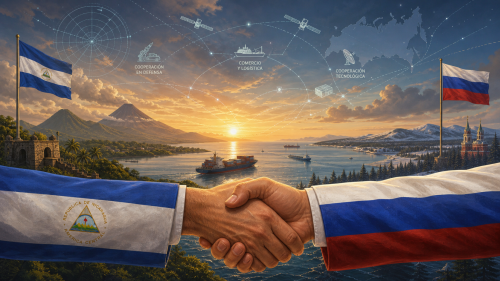
Nicaragua’s newly ratified military pact with Russia signals a clear deepening of multipolar ties in Central America, and it will likely trigger more pressure from Washington without immediately changing daily life for most expats on the ground.
TL;DR:
Nicaragua’s new military pact with Russia deepens long‑standing security ties and gives Managua more non‑US backing, while mainly serving as a pretext for Washington to increase sanctions and political pressure rather than launch direct conflict. For expats, daily life remains relatively safe and affordable in the near term, but over the longer run this geopolitical shift could mean higher costs, more banking and trade friction, and a need to stay financially flexible and prepared for any repeat of internal unrest like 2018, even though that scenario currently appears unlikely.
What Just Happened? The New Russia–Nicaragua Pact
In late April 2026, Russia’s Federation Council ratified a military cooperation agreement with Nicaragua that had been signed in Moscow in September 2025. According to Russian official documents, the pact covers joint troop training, exchanging experience and information on combating extremism and terrorism, collaboration between military academies, and cooperation in military‑scientific research on security issues.
Nicaraguan and Russian defense institutions will create working mechanisms to implement the agreement, and a multi‑year program of military cooperation is expected. This builds on long‑standing ties: Moscow has supplied weapons, training, and technical assistance to Nicaragua since the original Sandinista period, and more recently helped establish signals and surveillance capabilities at sites such as Cerro Mokorón near Managua.
From Managua’s perspective, this pact is about diversifying security partnerships and gaining training, technology, and political backing from a major non‑Western power.
Why Washington Cares: “Greater North America” and US Hegemony
The US national security bureaucracy has repeatedly framed the Western Hemisphere as a priority sphere where rivals like Russia and China must be pushed back. Current US strategic documents call for “restoring US dominance over the Western Hemisphere,” which includes preventing long‑term Russian military footholds from Mexico to Central America.
Recent US officials have floated the concept of “Greater North America,” rhetorically extending US strategic reach from the Arctic to the equator. In that framing, a Russian‑aligned, militarily connected Nicaragua becomes a target for pressure: sanctions, trade leverage, diplomatic isolation, and information campaigns.
Nicaragua is also one of the last core members of the ALBA bloc (with Cuba and Bolivia) after the US capture of Venezuelan president Nicolás Maduro in early 2026 and Washington’s resulting influence over Venezuelan energy exports. With Cuba under partial blockade and Bolivia swinging politically to the right again, Managua is now the most prominent remaining ALBA government, making it more symbolically important in the regional tug‑of‑war.
From Cold War to Today: How We Got Here
Nicaragua’s choice to double down on Russian ties did not arise in a vacuum. President Daniel Ortega, who built early ties with the Soviet Union in the 1980s, returned to office in 2007 and gradually rebuilt security and economic relations with Moscow.
The US re‑escalated pressure in 2018, combining sanctions with support for opposition sectors during a major political crisis that caused the economy to contract nearly 6% and wiped out roughly 417,000 jobs. Foreign investment dropped by about 90% between the first and second half of that year, and tourism collapsed. That experience reinforced Managua’s perception that relying on the US and traditional Western institutions makes the country vulnerable to external pressure.
Since then, Washington has expanded targeted sanctions under Executive Order 14088, focusing on the gold sector and state entities, while also threatening tariffs and the possible erosion of CAFTA‑DR benefits. As of 2026, the US is implementing phased Section 301 tariffs on Nicaraguan goods that fall outside CAFTA‑DR, starting at 0% in 2026 and rising to 10% in 2027 and 15% in 2028.
Against that backdrop, closer military‑strategic cooperation with Russia is both a political signal and a form of insurance: it aims to deter intervention, secure alternative training and technology, and deepen ties with a power that openly challenges unipolar dominance.
What More US “Meddling” Could Look Like
The analysis from the Estonian outlet Eesti Eest! argues that the pact will be used as a public pretext for intensifying US pressure, with scenarios ranging from tougher sanctions to embargo‑style measures or renewed support for armed groups similar to the old “Contras.”
Realistic levers Washington could use include:
Steeper trade pressure
The US is already weighing suspension or curtailment of CAFTA‑DR benefits and even tariffs up to 100% on some or all Nicaraguan imports, which would be phased in over months.
Sector‑focused sanctions
The existing focus on gold could expand to other export sectors, state‑owned enterprises, or financial institutions, while Europe and the UK continue targeted travel bans and asset freezes aimed at individuals and entities.
Covert or proxy destabilization
Latinoamerica21 notes that reports about Russia “upgrading Nicaragua’s military bases” and claims that Nicaragua is becoming a “Russian military base” help manufacture consent for more aggressive policies, from funding opposition networks to covert support for armed groups.
US strategy in the broader region—visible in Venezuela, Cuba, and elsewhere—usually aims at forcing political change while preserving a functional economy that can still serve as a market and source of resources. The author therefore expects pressure to ratchet up but not to the point of total collapse, in part to avoid large refugee flows toward the US.
Everyday Reality Now: Is Nicaragua Still Livable for Expats?
Despite the geopolitical drama, Nicaragua in 2025–2026 remains one of the safest and most affordable countries in Central America for residents and expats.
Key points for everyday life:
Safety
Nicaragua’s homicide rate—around 6.2 per 100,000—is lower than in roughly half of US states and much lower than in Costa Rica, Panama, Mexico, Guatemala, or Honduras. There is no widespread cartel warfare, and most expats live relatively normal lives in cities, small towns, and coastal areas.
Cost of living
The cost of living is estimated at approximately 50% below that of the US, with a single property‑owning expat in a town like San Juan del Sur able to live decently from roughly 1,200 USD per month, and a couple from 1,500–2,500 USD. Local food, transport, and basic services remain comparatively inexpensive.
Economic resilience
Nicaragua produces over 90% of its basic food domestically, has falling public debt (around 45% of GDP), moderate inflation (projected 2–4%), and foreign reserves covering about seven months of imports. Trade diversification, including a free trade agreement with China that eliminates tariffs on most goods over time, reduces dependence on US markets.
For expats already on the ground, daily life is dominated far more by local realities than by high‑level geopolitical maneuvers.
Medium‑Term Outlook: Worst‑Case vs Likely Path
Even under a pessimistic scenario of heightened US interference, change would unfold over years, not overnight. The worst‑case path looks like this:
Gradual economic reorientation
Pressure to privatize state programs, reduce subsidies on fuel and basic goods, and favor foreign corporate suppliers could raise prices, weaken labor protections, and increase inequality.
Security degradation
If economic stress and external meddling deepen, crime and drug trafficking could expand, as happened in Costa Rica, where the homicide rate surged to around 17 per 100,000 and criminal organizations multiplied roughly tenfold over a decade.
Social atmosphere
The easygoing, community‑oriented vibe that many expats value could become more strained as living costs rise and social protections weaken, though the climate, geography, and basic culture would remain.
Even then, expats would most likely adapt—shifting from integrated neighborhoods to more controlled communities where necessary, paying more for security and services, but still finding Nicaragua viable.
The truly sharp risk is not gradual US pressure but a sudden internal crisis similar to 2018, when protests and clashes devastated the economy and tourism in a matter of months. That scenario, rather than the Russia pact itself, is what could most quickly reshape conditions for foreigners.
What This Means in Practice for Expats and Future Movers
1. Short‑Term (next 1–3 years)
- Day‑to‑day life likely remains much as it is now: safe by regional standards, affordable, and relatively stable for foreign residents.
- Expect more anti‑Nicaragua rhetoric and media narratives in US and allied outlets, especially framing the Russia pact as a threat. This can translate into changes in travel advisories or banking friction rather than immediate local upheaval.
2. Financial and Legal Considerations
- Banking and payments
Some US and European banks may de‑risk by limiting services connected to Nicaragua or to sanctioned entities, but there are currently no broad UN sanctions, and European measures remain targeted. Expats should diversify banking (multiple jurisdictions, some local accounts, some offshore) and avoid doing business with sanctioned entities.
- Property and investment
External pressure can slow foreign investment and affect resale liquidity, but it does not automatically mean property confiscation or expat‑specific targeting. The biggest risk is buying aggressively at speculative prices in highly foreign‑dependent micro‑markets (for example, certain coastal bubbles) that would be vulnerable to a tourism downturn.
3. Lifestyle and Security Positioning
- Integrated vs bubble
Nicaragua currently allows a choice: living in integrated local neighborhoods at low cost, or in more insulated expat communities at higher cost. In a deteriorating security scenario, the balance could tilt toward needing more gates and guards, but that shift would likely be gradual.
- Information hygiene
Both US‑aligned and opposition media often frame Nicaragua either as a security threat or a failed state; local pro‑government outlets emphasize sovereignty and stability. A grounded expat approach is to watch all sides, cross‑check with on‑the‑ground experience, and understand how narratives are used to justify policy moves.
Anti‑Imperialist Lens: Multipolarity vs Intervention
Seen from a more anti‑imperialist angle, the Russia–Nicaragua pact is part of a broader trend where smaller nations seek to balance US dominance by building relations with Russia, China, and other Global South partners. Nicaragua’s food sovereignty, growing links with China through the free trade agreement, and military cooperation with Russia all reduce the leverage of any single external power.
At the same time, Washington’s response—tariffs, sanctions, and rhetorical campaigns—follows a well‑known pattern in which economic tools are used to discipline states that refuse to align fully with US preferences.
For expats who value sovereignty and multipolarity, staying in Nicaragua can be seen as a conscious choice to live in a country trying to chart a more independent course, accepting that this independence invites pushback.
Practical Takeaways for Expats
- If you are already in Nicaragua and comfortable with some geopolitical “noise,” the medium‑term outlook still appears workable, especially if you keep financial options diversified and avoid over‑concentration in any one sector.
- If you are considering moving, the main question is your risk tolerance: are you willing to accept potential long‑term increases in prices, some policy unpredictability, and a higher chance of sanctions‑related friction in exchange for lower current costs, higher food security, and living in a less US‑dominated space?
- The Russia pact does not, by itself, suddenly transform Nicaragua into a conflict zone. It formalizes and deepens a relationship that has existed for decades, and it primarily changes Washington’s justification narrative rather than the on‑the‑ground reality—at least for now.
Summary: Nicaragua’s New Russia Pact: What It Means for Expats
Nicaragua’s newly ratified military cooperation pact with Russia deepens long‑standing ties in training, security, and technology, and will likely be used by Washington as a justification for more sanctions and political pressure rather than direct conflict.
For expats, this is primarily a geopolitical backdrop: daily life in Nicaragua remains safe and affordable by regional standards, with strong local food production and a still‑functioning economy, though future US measures could slowly raise costs, complicate banking, and increase long‑term uncertainty.
The real risk for foreigners is not the pact itself but a hypothetical return of internal unrest or externally fueled instability like in 2018, which could quickly hit tourism, jobs, and social calm, so it still makes sense for expats to stay informed, keep finances diversified, and maintain flexible plans rather than assuming everything will stay the same forever.
That said, the likelihood of a full repeat of 2018 appears very low, as the government has tightened control, opposition networks are more fragmented, and many local actors remember the economic damage and are cautious about sliding back into that kind of chaos.
Further reading and sources:
Tass: Russia, Nicaragua sign agreement on defense cooperation
Havanatimes: Russia Approves Military Cooperation Pact with Nicaragua
Latinoamerica21: Russia’s strategic presence in Central America
Colombiaone: Russia and Nicaragua Sign Joint Military Cooperation Agreement
Tass: Russian parliament’s upper house ratifies military cooperation pact with Nicaragua
Confidencial: Russia Ratifies Military Cooperation Pact with Nicaragua
Eesti Eest!: Nicaragua’s Newly Ratified Military Pact With Russia Will Likely Prompt More US Meddling
Related articles:
Nicaragua Braces for Economic Turbulence as Trump Threatens 100% U.S. Tariffs
US–Venezuela War Talk: What It Could Mean For Nicaragua’s Economy
U.S. National Emergency Over Nicaragua Explained: Sanctions and 2018 Move
The Donroe Doctrine: Old Hegemony in New Packaging
Current U.S. Pressure on Nicaragua: Recent Diplomatic Moves