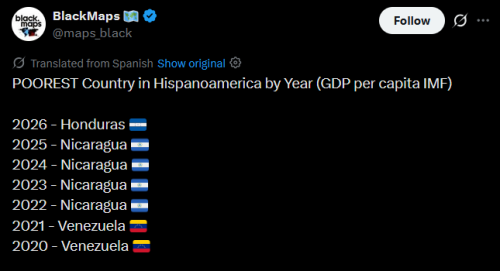
GDP per capita is a flawed yardstick for Nicaragua and similar countries.
It understates real living standards which are way better then the GDP metric suggests.
If one reads "poorest country", that gives a reader the impression it must be REALLY bad. That is done intentionally so you never go there to check it out yourself.
Here is why GDP is a deceptional metric (but used intentionally):
TL;DR
- Nicaragua’s “poorest country” label is based on nominal GDP per capita (~$3,000–$3,300), which is a poor measure of living standards.
- Adjusted for purchasing power, output per person is roughly $8,700–$9,800 — about 3x the headline.
- Remittances (27–29% of GDP) add real household income that GDP misses, though they also reflect limited domestic livelihoods and exposure to US shocks.
- Poverty has fallen from above 16% in 2021 to below 14% in 2025; public debt is moderate (51% of GDP, mostly concessional).
- But the correction has limits: Nicaragua still ranks around 134th–138th globally in PPP, HDI is below the regional average, and cheap prices also reflect low wages and productivity.
- Bottom line: GDP understates Nicaragua, but better measures — PPP, GNI, poverty, HDI — show it is still poor, just not as dire as the ranking suggests.
Introduction: One number, many distortions
GDP per capita is the most quoted number in development economics. The IMF publishes it for almost every country, news outlets rank countries by it, and it is often treated as shorthand for "how developed is this place?" Nicaragua usually lands near the bottom of the Latin American table on this measure. Depending on the source and year, its nominal GDP per capita sits somewhere between roughly $2,300 and $3,300, and its PPP figure between roughly $7,700 and $9,800. Sources disagree because of revisions, population estimates and exchange-rate treatment, which is itself a lesson about how fragile the number is.
This article does two things. First, it explains why GDP per capita is a poor tool for comparing countries at different development levels, using Nicaragua as the running example. Second, it asks the harder question: once you correct for those flaws, is Nicaragua "better off in reality" than the headline suggests? The honest answer is: in some ways yes, in others no, and the correction does not close the gap with richer neighbors. Both halves matter, and a piece that gave only one would be propaganda in one direction or the other.
Part 1: The technical problems with GDP per capita
1. It uses market exchange rates, which ignore what money buys
Nominal GDP per capita converts each country's output into US dollars at the going exchange rate. But a dollar does not buy the same things everywhere. In Nicaragua, food, rent, local transport, haircuts, restaurant meals and domestic labor cost a fraction of what they cost in the US or Costa Rica. A household earning a few hundred dollars a month can live at a standard that would be impossible on the same dollars in Miami.
Purchasing power parity (PPP) adjusts for this by asking how much a common basket of goods costs in each country. For Nicaragua the adjustment is dramatic. One IMF-based dataset puts nominal GDP per capita at about $3,173 for 2025 (ranked around 140th of 197) and PPP GDP per capita at about $8,709 (ranked around 138th). Another puts the 2025 figures at roughly $3,337 nominal and $9,765 PPP. In both cases, PPP is close to three times the nominal figure. Comparing Nicaragua's nominal number to Mexico's or Panama's is comparing different units of value.
PPP is not a perfect fix. Baskets differ, and PPP estimates for small economies rely on infrequent price surveys. But it is clearly closer to lived reality than the nominal number.
2. It is an average, not a picture of how people actually live
Dividing total output by population produces a mean. If a small group captures most of the gains, the mean rises while the typical person's life barely changes. GDP per capita says nothing about the gap between Managua and the rural interior or the Caribbean coast, between formal and informal workers, or between men and women.
A more informative picture would use median income, the Gini coefficient, the income share of the poorest 40 percent, and poverty headcounts. For Nicaragua, the World Bank's nowcasts indicate that poverty (at the US$4.20 per day line, 2021 PPP) fell from above 16 percent in 2021 to below 14 percent in 2025. That is a distributional story the headline figure cannot tell.
3. It excludes most non-market activity
GDP counts goods and services that are bought and sold, plus some imputed values such as owner-occupied housing. It largely misses unpaid household production: cooking, child care, elder care, fetching water and fuel, building and repairing one's own home, and subsistence farming. In a country with a large rural population and widespread family-based production, this omission is large.
A smallholder family that grows its own maize and beans, raises chickens, builds with local materials and shares labor with neighbors consumes real goods that never pass through a market. Surveys may capture part of this, but not all. GDP per capita therefore understates living standards in economies with a big non-market sector, and the understatement is larger the poorer and more rural the country.
4. The informal economy is poorly measured
Most Nicaraguan workers are employed informally, without contracts, social security contributions or registration. Informal activity is estimated from surveys and indirect methods, and the estimates carry wide error bars. Undercounting understates GDP, while mismeasurement in the other direction overstates it. Either way, the uncertainty around a country like Nicaragua is wider than the neat decimals in the IMF table suggest.
5. Remittances: the biggest Nicaragua-specific distortion
GDP measures production inside a country's borders. Remittances, the money emigrants send home, are income that residents receive but that was not produced inside the country. They show up in Gross National Income (GNI) and disposable income, not in GDP.
For Nicaragua the amounts are enormous. Remittances were roughly 27 percent of GDP in 2024 and rose to about 29 percent in 2025, with the large majority coming from the US. In most middle-income countries remittances are a low single-digit share of GDP. In practical terms, a very large number of Nicaraguan households have a second income stream that is invisible in GDP per capita. Studies of remittance-receiving countries consistently find that this money goes to food, housing, school fees and health care, and sometimes to small business investment.
GNI per capita, or better still household disposable income per capita, would raise Nicaragua's apparent standing. The IMF headline table does not do this.
6. ...but remittances also show why the picture is not purely rosy
Remittances are not a pure good-news story. They exist because many people could not find adequate livelihoods at home. High dependence makes household welfare vulnerable to events abroad: US recessions, immigration enforcement, new taxes on remittances, or restrictive policies. Remittances also tend to appreciate the exchange rate and can pull workers out of local production. A country that looks "richer than its GDP" because of remittances is partly relying on conditions elsewhere. That is different in kind from a country whose higher income comes from domestic productivity.
7. It ignores health, education and basic capabilities
Development is about what people can do and be: live long, be healthy, read, learn, participate. GDP per capita captures none of that directly. The Human Development Index (HDI) was created to supplement it by combining income with life expectancy and years of schooling. Countries with the same GDP per capita can have very different HDI values.
Nicaragua has made real gains in some areas, such as the expansion of basic health services, and life expectancy is in the mid-70s. On other measures, such as years of schooling and educational quality, it lags regional leaders. A single income number cannot capture this mixed pattern.
8. It treats all spending as equally valuable
GDP counts spending on rebuilding after a hurricane, policing crime, treating pollution-related disease or buying military hardware as positive output. Nicaragua is exposed to hurricanes (Eta and Iota in 2020), earthquakes and volcanic activity, so reconstruction spending boosts measured output even though the underlying event destroyed wealth. GDP does not distinguish spending that raises well-being from spending that merely repairs damage.
9. It ignores natural capital and the environment
GDP does not subtract the depletion of forests, soil, water or minerals. A country can raise measured output by cutting forests or over-fishing, and the accounts record only the gain. Nicaragua has substantial natural assets, including large lakes, forests and farmland, and a significant share of its electricity comes from renewable sources. Deforestation along the agricultural frontier is a serious problem, though.
[24.10.2026 06:49] Tobi: Neither the asset base nor its depletion appears in GDP per capita.
10. It is a flow, not a stock of wealth
GDP measures output in a year, not what a society owns: land, housing, infrastructure, savings, human capital. Two countries with the same annual output can differ greatly in wealth and resilience. Many Nicaraguan families own their homes and land outright, even if modest, which provides a kind of security that does not show up in annual income.
11. Volatility and revisions in small economies
Nicaragua's economy is small, roughly $20 billion in current dollars, with a population near 7 million. Small economies swing with commodity prices (gold was about 18 percent of exports in 2024, alongside coffee and beef), exchange-rate adjustments and base-year revisions. A change in the deflator or the population estimate can shift per capita figures by several percentage points, which is why institutions publish different numbers for the same year.
12. Data quality, transparency and politics
The quality of national statistics depends on funding, independence and transparency. Nicaragua has reduced the publication of some statistics and independent research has been restricted in recent years, so outside analysts rely on a narrower set of data. Governments everywhere have incentives to present figures favorably, and the IMF largely accepts country-submitted data after consistency checks. Treat any single figure for any country, including Nicaragua, with some skepticism.
13. It says nothing about the structure of the economy
Two economies with identical GDP per capita can have different structures. A resource-exporting economy can show high GDP per capita with narrow benefits (Equatorial Guinea is the classic case), while a diversified economy of many small firms may show a lower figure but broader resilience. GDP per capita does not tell you whether growth is broad-based and sustainable or dependent on one commodity.
14. It mixes in shocks from trade and sanctions
External policy changes shift measured output without reflecting the underlying capabilities of the population. In August 2025 the US imposed an 18 percent tariff on goods from Nicaragua, and there have been threats to its place in the CAFTA-DR trade agreement. The US is Nicaragua's largest export customer, taking around half of exports in 2024. These are shocks outside the control of ordinary households, and a snapshot of GDP per capita does not separate them from domestic performance.
Part 2: Where Nicaragua looks better once you correct the picture
Price-adjusted, it is about three times richer than the nominal figure. Moving from nominal to PPP lifts Nicaragua from roughly $3,000 to roughly $9,000 per capita. One dataset shows Samoa with almost double Nicaragua's nominal figure but nearly identical PPP income.
Remittances add a large, uncounted income stream. With remittances near 29 percent of GDP, household disposable income per person is substantially higher than GDP per capita implies. That is one reason private consumption has grown and poverty has fallen even though production per person is low.
Poverty has been falling. The World Bank estimates poverty at the $4.20-a-day line fell from above 16 percent in 2021 to below 14 percent in 2025, helped by growth (about 4.9 percent in 2025), a stable labor market and the surge in remittances.
Public finances are relatively sound. Public debt declined to about 51 percent of GDP in 2025 according to the World Bank, and external debt is largely concessional. That is a stronger position than many peers.
Non-market living standards are undercounted. Rural households that produce their own food, own their homes and rely on community networks enjoy consumption and security that GDP misses.
Some quality-of-life indicators are better than income suggests. Nicaragua has historically reported lower homicide rates than Honduras, El Salvador and Guatemala, and generally lower living costs. Official crime statistics in the region should be read cautiously, but personal safety is a genuine part of how people experience daily life.
A large share of electricity is renewable. The country has invested in hydro, wind, geothermal and solar generation, which GDP does not credit.
Taken together: Nicaragua's material living standard is meaningfully higher than a naive reading of the nominal GDP-per-capita ranking suggests.
Part 3: Where the correction runs out
Even in PPP terms, Nicaragua is poor by regional standards. Adjusted for prices, it still ranks roughly in the bottom third of the world (around 134th to 138th depending on the dataset) and is at or near the bottom in Latin America, with only Haiti clearly below it and Honduras close. Costa Rica, Panama, Mexico and Chile have PPP incomes several times higher. Correcting the metric narrows the gap but does not erase it.
HDI tells a similar story. Nicaragua's HDI is in the "medium" band, below the Latin American average and below Costa Rica, Panama, Mexico and El Salvador. Educational attainment and quality are the weaker components.
Remittance dependence is a vulnerability. The same inflows that boost household income depend on Nicaraguan migrants abroad. The World Bank expects remittance and export growth to slow in 2026 because of tariffs and weaker migrant income, and forecasts growth moderating to roughly 3 to 4 percent.
Informality and low productivity remain high. Most workers lack formal contracts, social security or stable wages, and a large share work in agriculture and low-wage services.
Statistical opacity limits what we can claim. Fewer independent data sources mean greater uncertainty, including for the optimistic indicators above.
Part 4: A fairer scorecard
To compare Nicaragua with its neighbors properly, use a dashboard instead of one number:
- GDP per capita, PPP (price-adjusted production)
- GNI per capita, PPP (includes remittances and income flows)
- Household disposable income or consumption per capita (what families actually spend)
- Median income and Gini coefficient (distribution)
- Multidimensional Poverty Index (health, education, living standards)
- Human Development Index (income, health, schooling)
- Safety indicators (homicide rates, with caution about data quality)
- Governance and freedom indices (political and civil liberties)
- Resilience indicators (debt, export concentration, remittance dependence)
On such a dashboard Nicaragua shows up as better than its nominal GDP per capita implies on prices, remittance-supported incomes and poverty reduction; roughly average-to-weak on human development; and weak on freedoms and opportunity, as shown by emigration.
Conclusion
The headline understates Nicaragua. Adjusted for prices, its output per person is about three times the nominal figure. Remittances add real household income that GDP never counts. Poverty has been falling, public debt is moderate and mostly concessional, and a large share of electricity is renewable. The fair way to judge a country is with better measures: PPP, GNI, poverty rates and HDI. On those, Nicaragua is clearly doing better than the ranking table suggests.
Related articles:
Nicaragua Braces for Economic Turbulence as Trump Threatens 100% U.S. Tariffs
U.S. National Emergency Over Nicaragua Explained: Sanctions and 2018 Move
The Donroe Doctrine: Old Hegemony in New Packaging
Current U.S. Pressure on Nicaragua: Recent Diplomatic Moves
Nicaragua’s Russia Military Pact: What It Really Means for Expats