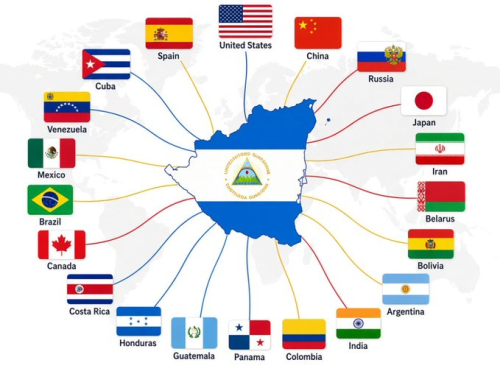
Mainstream media likes to portray Nicaragua as an isolated country.
Nicaragua has many trading and political partners.
Here is a list!
Nicaragua’s partnerships fall into a few clear types:
- large economic partners (especially the United States)
- fast-growing political and investment partners (especially China and Russia)
- long-standing ideological allies (Cuba and Venezuela)
- practical neighbors in Central America.
🇦🇷 Argentina
Type of partner: Routine South American diplomatic and trade contact.
Relations date to 1882 and remain correct but low-intensity. Trade exists (mainly Argentine food and industrial goods) without a free-trade agreement or large investment. Political alignment is limited; Buenos Aires has been critical of Nicaragua’s internal situation. Not a priority partner.
🇧🇾 Belarus
Type of partner: Political ally with modest practical weight.
Ties grew after 2007 and again after both countries faced Western sanctions. They often take similar positions in international forums. Trade and people-to-people links are small. Useful for diplomatic support, not for the Nicaraguan economy.
🇧🇴 Bolivia
Type of partner: Ideological and ALBA partner.
The relationship is strongest inside ALBA-TCP: shared language on sovereignty and regional integration. Trade and migration are modest. Bolivia matters more as a political companion than as a market or investor.
🇧🇷 Brazil
Type of partner: Formal Latin American relation under strain.
Diplomatic ties are old (1906), but political trust fell after Nicaragua expelled Brazil’s ambassador in 2024 and Brazil responded. Consular work continues. Trade is real but not among Nicaragua’s top flows. Currently a cool, secondary relationship.
🇨🇦 Canada
Type of partner: Mining and gold-market partner with political distance.
Canada is important because Canadian firms have been major players in Nicaraguan gold and because Canada buys some of that gold. Ottawa has also sanctioned Nicaraguan officials and keeps a limited diplomatic footprint. Economic link is narrower but more concrete than the political one.
🇨🇳 China
Type of partner: Main new political, infrastructure and import partner.
Nicaragua recognized Beijing in 1985, switched to Taiwan in 1990, and returned to China in December 2021. Since then ties have moved quickly: a free-trade agreement in force from January 2024, large Chinese imports, and projects in ports (Corinto), roads, buses, housing, telecoms and mining. Exports from Nicaragua to China remain small, so the trade balance is heavily in China’s favor. In 2026 Managua also authorized Chinese military personnel for exercises and related activities. China is now Nicaragua’s central non-Western partner for investment and political backing.
🇨🇴 Colombia
Type of partner: Neighborly trade partner with political friction.
One of Nicaragua’s oldest relationships (1825). There is a partial-scope trade agreement and regular commercial exchange. High-level politics have been cooler because of disagreements over governance. Useful commercially, limited politically.
🇨🇷 Costa Rica
Type of partner: Closest everyday neighbor — trade plus a large migrant community.
Geography makes this relationship unavoidable. Costa Rica is a major Central American trade partner under SICA and CAFTA-DR, and it hosts one of the largest Nicaraguan communities abroad. Border management, irregular migration and political criticism from San José regularly create tension. For many Nicaraguan families this is one of the most important relationships in daily life.
🇨🇺 Cuba
Type of partner: Long-standing political and cooperation ally.
Ties go back to 1905 and became especially close after 1979. The relationship is strongest in politics, health, education and ALBA coordination, not in large-scale trade. Cuban doctors and advisors have been a visible part of cooperation for decades. Cuba remains one of Managua’s closest political companions.
🇸🇻 El Salvador
Type of partner: Practical Central American trade neighbor.
A standard SICA and CAFTA-DR relationship. El Salvador is regularly among Nicaragua’s more important regional markets and suppliers. Political styles differ, but the link is mostly commercial and neighborly rather than ideological.
🇬🇹 Guatemala
Type of partner: Core Central American trade partner.
Guatemala is consistently one of Nicaragua’s leading import sources and a relevant export market inside the isthmus. Diplomacy is generally businesslike. This is a working regional partnership more than a strategic alliance.
🇭🇳 Honduras
Type of partner: Everyday isthmian neighbor.
Trade, border traffic and SICA/CAFTA-DR rules define the relationship. There have been periodic frictions, but nothing that changes the basic pattern: Honduras matters as a next-door commercial and social partner.
🇮🇳 India
Type of partner: Secondary trade and diplomatic contact.
Relations since 1972. India supplies pharmaceuticals, vehicles and other manufactures at a mid-tier level. No major political alignment and no large diaspora link. Present, but not central.
🇮🇷 Iran
Type of partner: Political partner with still-small economic weight.
Relations date to 1976 and were revived after 2007. The two governments often support each other in international forums. Trade remains limited; the value of the relationship is mainly diplomatic and geopolitical rather than commercial.
🇯🇵 Japan
Type of partner: Traditional aid and import partner, now less central.
Japan was for years an important source of development assistance and still sells vehicles and machinery. Political relations are correct but distant after Japan joined Western criticism of Nicaragua’s internal situation. Historical partner more than current strategic one.
🇲🇽 Mexico
Type of partner: Major Latin American trade and regional partner.
One of Nicaragua’s oldest relationships (1839). Mexico is usually among the top import sources and a relevant export market. Diplomacy stays open even when Mexico comments on Nicaraguan politics. After the United States and China, Mexico is one of the more important “normal” economic partners.
🇵🇦 Panama
Type of partner: Logistics and regional trade partner.
Panama matters because of shipping, re-exports and services linked to the Canal. Political content is limited. A useful commercial hinge rather than a close political ally.
🇷🇺 Russia
Type of partner: Main security and political partner outside the Americas.
The relationship was built in the 1980s, quieted after 1990, and rebuilt after 2007. Nicaragua has supported Russia at the UN and on Ukraine. Russia supplies most of Nicaragua’s heavy military equipment (tanks, helicopters, aircraft, air defense) and has expanded police and military cooperation. A 2025 military cooperation agreement was ratified by Russia in 2026; Managua also authorized Russian military personnel for activities on its territory. Trade is still modest compared with the United States or China. Russia’s value to Nicaragua is political cover and security cooperation.
🇪🇸 Spain
Type of partner: Historical European partner now politically distant.
Relations since 1851. Language, history and a Nicaraguan community in Spain still matter. High-level politics deteriorated after 2021, with mutual expulsions. Consular services continue. More a cultural and residual economic link than an active political partnership.
🇺🇸 United States
Type of partner: Largest economic partner and main political counterpart.
This is Nicaragua’s most important relationship in material terms and its most conflicted politically. The United States is the top export market (apparel, gold, beef, coffee and other goods, much of it under CAFTA-DR), a leading import source, and the origin of the great majority of remittances — a flow equal to roughly a quarter or more of GDP. A large Nicaraguan community lives in the United States. At the same time, Washington has added sanctions, extra tariffs on some non-CAFTA goods, and pressure over labor, governance and Nicaragua’s ties with China and Russia. Embassies remain open. No other country combines this much economic weight with this much political tension.
🇻🇪 Venezuela
Type of partner: Core political ally, weaker economically than before.
The relationship became central after 1999–2007 through ALBA and earlier oil cooperation. Political support remains strong; Nicaragua has backed Venezuela in regional and international disputes. Preferential oil and large financial flows have faded as Venezuela’s own capacity declined. Today the partnership is mainly political and symbolic, with some remaining ALBA trade and coordination.
Related articles:
Nicaragua Braces for Economic Turbulence as Trump Threatens 100% U.S. Tariffs
U.S. National Emergency Over Nicaragua Explained: Sanctions and 2018 Move
The Donroe Doctrine: Old Hegemony in New Packaging
Current U.S. Pressure on Nicaragua: Recent Diplomatic Moves
Nicaragua’s Russia Military Pact: What It Really Means for Expats